
Caregiver’s Authorization Affidavit
Are you caring for a child relative and facing barriers when attempting to address their medical or educational needs?
Kentucky law allows relative caregivers who are caring for a child without legal custody or guardianship to complete a form, called a Caregiver’s Authorization Affidavit, stating that they are the child’s primary caregiver. With a completed affidavit, caregivers may authorize health care treatment as well as act as the child’s legal contact for school-related decisions, such as enrollment, attendance, and discipline.
The affidavit is valid for one year from the date it is signed and may be renewed annually unless revoked by a parent, guardian, legal custodian, or de facto custodian.
Please note: An affidavit does not give a caregiver the status of a de facto custodian, guardian, or legal custodian of the child. If you would like assistance pursuing guardianship status, please refer to the Kinship Care Handbook.
How to Use the Caregiver’s Authorization Affidavit
If this situation applies to you:
- Fill out the Caregiver’s Authorization Affidavit
- Take the affidavit to your County Clerk’s Office to be notarized
- Provide the notarized affidavit to:
- The child’s health care provider for medical decisions
- The child’s school for educational decisions
Things to Know Before Using the Affidavit
- If there is more than one child, you must complete a separate affidavit for each child.
- Your relationship to the child must be documented (for example: grandparent, aunt, uncle, sibling, cousin).
- If you are unable to locate the child’s parents or legal guardians, you must describe the reasonable efforts you made to contact them, such as phone calls, texts, or contacting other relatives, in the space provided.
- If you have court-recognized legal custody or guardianship, you do not need to complete this affidavit, as you already have the authority to make medical and educational decisions.
Legal Notice
Use of the Caregiver’s Authorization Affidavit is authorized under KRS 405.024 and KRS 158.144. This affidavit is completed under penalty of perjury, meaning all information provided must be true and correct to the best of your knowledge. Knowingly providing false or incorrect information may result in legal consequences, including fines or other penalties.
This information is provided for general guidance only and is not intended to serve as legal advice. If you have questions about completing or using this affidavit, you may wish to seek advice from an attorney.
Information for Health Care Providers
- A healthcare provider who relies on a properly completed affidavit is not required to conduct any additional investigation and is protected from criminal, civil, or professional liability for relying on the affidavit.
- A provider must honor a caregiver’s authorization to seek or refuse health care treatment for a minor when the caregiver presents this affidavit.
- A provider must not honor the caregiver’s decision if the provider has actual knowledge that a parent, guardian, legal custodian, or de facto custodian has made a superseding decision regarding the child’s care.
- Nothing in this affidavit prevents a provider from delivering medical treatment when delaying care would reasonably threaten the health or life of the child.
Information for School Officials
- A school official who relies on a properly completed affidavit is not required to conduct any additional investigation and is protected from criminal, civil, or professional liability for relying on the affidavit.
- A school official must not honor the affidavit if there are reasonable grounds to believe it is being used solely to enroll a student for athletics or to circumvent school choice policies.
- The affidavit does not override protections or requirements under the Individuals with Disabilities Education ACT (IDEA), Section 504 of the Rehabilitation Act, or the Family Educational Rights and Privacy Act (FERPA).
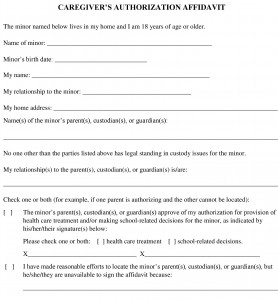
The Caregiver’s Authorization Affidavit was developed by Kentucky Youth Advocates, in partnership with AppalReD Legal Aid and the Kinship Families Coalition of Kentucky, to serve as a model template for caregivers to use and for partners to disseminate.